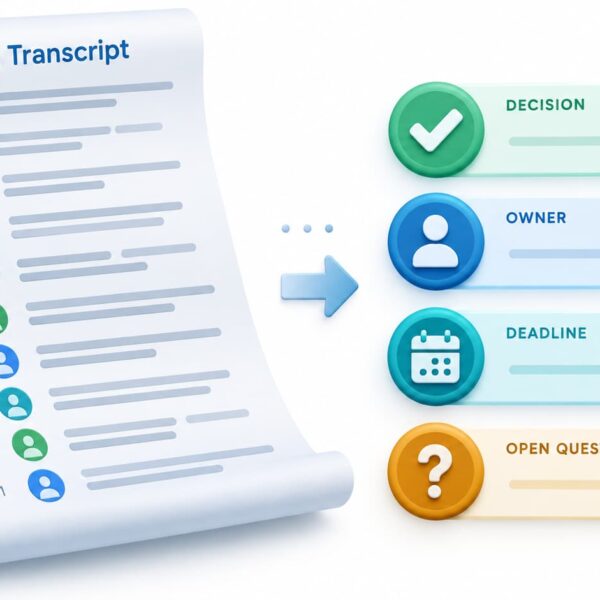
Automatic transcription solves a genuine problem: nobody has to type every sentence spoken during a meeting. The resulting document can preserve names, timestamps, questions and explanations that would otherwise disappear. Yet a faithful conversation record is not automatically a useful work record.
Teams still need to know what was approved, who owns the next action, when it is due and which issues remain open. Unless those elements are confirmed separately, a searchable transcript can leave everyone well informed and nobody accountable.
A Transcript Can Leave Decisions Unclear
Meetings rarely produce decisions in neat sentences. One participant proposes an option, another adds a condition, a third raises a concern, and the chair closes the discussion with “That sounds good.” The transcript preserves all four contributions but may not show whether the proposal was approved with the condition, postponed or merely received politely.
Ordinary conversation also contains corrections, humour, unfinished thoughts and references such as “the earlier version.” A colleague reading the text two weeks later may not know which document that phrase identified. Spoken agreement depends on context that a line-by-line record does not organise.
Four Records Serve Different Purposes
Confusion begins when transcript, notes, minutes and task records are treated as interchangeable. Each format answers a different question and belongs at a different level of detail.
| Record | Main purpose | Essential content |
| Transcript | Preserve the conversation | Speakers, words and timestamps |
| Meeting notes | Summarise useful context | Main arguments, evidence and questions |
| Decision log | Record an authorised choice | Decision, date, owner and rationale |
| Task record | Make follow-up visible | Action, assignee, deadline and status |
A transcript is strongest as supporting evidence. It helps resolve uncertainty about what was said and gives absent colleagues access to the discussion. The shorter records should carry the operational result because they can be scanned, assigned and updated.
Summaries Can Still Miss the Turning Point
AI-generated summaries reduce reading time, but compression introduces another judgment layer. A system may identify the most frequently discussed option even though the group rejected it near the end. It may convert a tentative offer—“I could draft that”—into an assignment, or omit a condition mentioned only once.
Speaker identification and punctuation can create additional ambiguity. Similar voices, poor audio, specialised names and participants speaking over one another all affect the source text. A polished summary may therefore sound more certain than the meeting actually was.
Human review does not require rewriting the conversation. It requires checking each claimed decision against the closing discussion and obtaining confirmation when the language remains unclear.
Decisions Need a Compact Structure
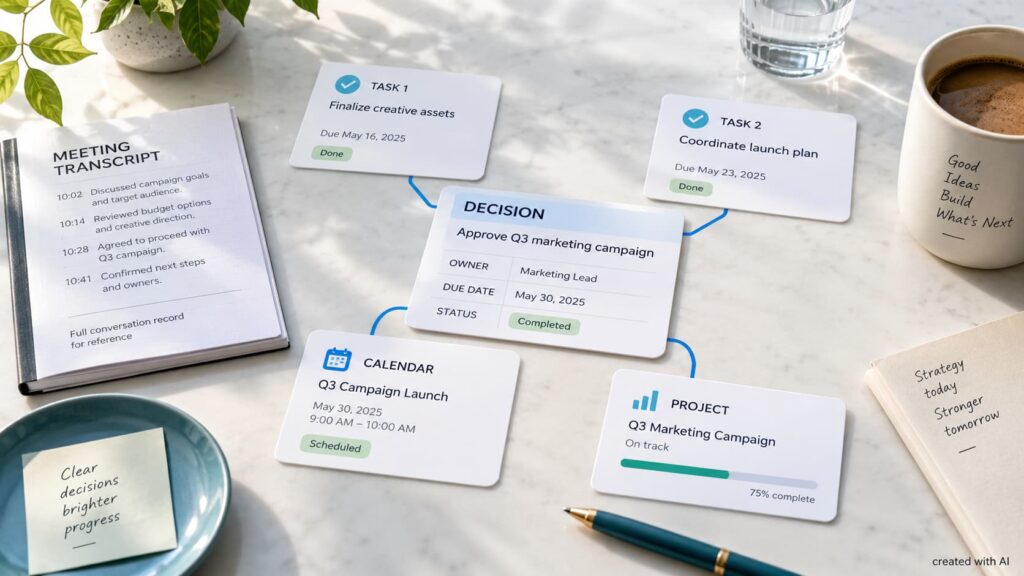
A useful decision entry can fit in a few lines. It should state the chosen course, the person authorised to carry it forward, the date of the decision and the reason that mattered. A review date is valuable when the choice depends on an assumption that may change.
Action items require even greater precision. “Marketing will prepare the launch” names a department but not an accountable owner or deliverable. “Maya will submit the approved launch schedule by 16 May” can be placed in a task manager and checked without replaying the meeting.
Meeting Software Does Not Formalise Decisions
Microsoft’s Teams transcription documentation describes live transcripts as a real-time capture of spoken content with speaker names and timestamps. That is valuable evidence, but the feature’s basic output does not decide which remarks constitute formal approval or assign responsibility for follow-up.
Storage also deserves attention. Microsoft notes that organisers can control access and delete transcripts. Sensitive discussions therefore need clear rules covering consent, permissions, retention and whether the full transcript should exist after verified minutes have been published.
A Five-Minute Closing Routine Prevents Confusion
The final minutes of a meeting should convert conversation into confirmed work. This routine can remain consistent even when different conferencing and project-management apps are used.
- Read each decision aloud in one complete sentence.
- Confirm any conditions, exclusions and assumptions attached to it.
- Give every action one named owner and a specific deliverable.
- Agree on a deadline or an explicit date for reassessment.
- Record unresolved questions separately instead of disguising them as tasks.
- Link the task and decision entries back to the notes or transcript.
The meeting chair can perform this check, although another participant should document the results. Separating facilitation and note ownership reduces the chance that the person guiding discussion also has to reconstruct it afterward.
GitLab’s published all-remote meeting practices illustrate the distinction. Its handbook recommends capturing action items in issues or merge requests and linking them to the meeting agenda, while recordings and transcripts provide additional context.
The Short Record Should Lead
A transcript may contain every word and still force each colleague to interpret the outcome independently. That is expensive documentation: comprehensive, searchable and operationally weak.
The decision log and task system should become the primary work records. Notes explain the reasoning, while the transcript remains available when detail or disputed wording matters. This hierarchy preserves context without asking a forty-page conversation to manage a project.