
Wholesale distributors hit the same wall every day. Customers call after hours to place orders. Sales reps wander warehouses, guessing what’s in stock. Accounting teams re-enter order details from paper forms into QuickBooks.
Most platforms patch one hole. They leave the others open.
Zoey and B2B Wave approach this differently. Both are B2B eCommerce platforms purpose-built for wholesale. Customers get a self-service ordering portal. Sales reps get a mobile ordering app. Both sync with QuickBooks and other accounting tools.
A B2B ordering platform connects three groups: customers, sales teams, and the back office. Phone orders stop. Reps see real-time inventory. Accounting gets clean data without double entry.
Here are three platforms that handle these connections.
1. SimplyDepo
SimplyDepo serves CPG brands that self-distribute their products. The platform includes a B2B storefront where retailers log in with their own credentials. They see their negotiated pricing. They place orders without calling a sales rep.
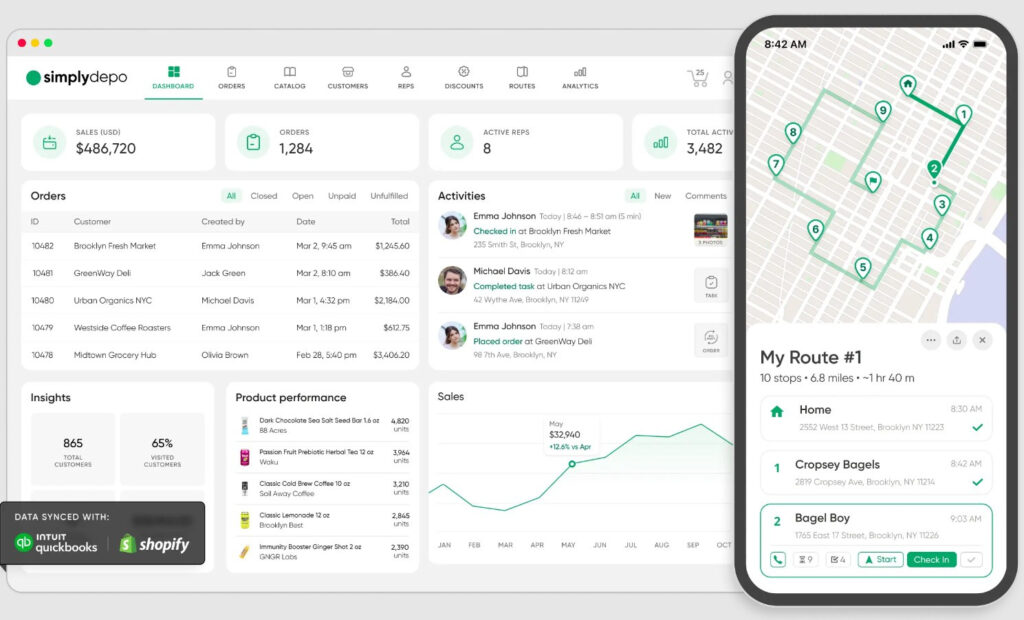
The same system works offline for field sales. Reps capture orders in store basements, warehouses, and rural routes without internet. Data syncs when connectivity returns. Managers view orders, visit history, and field activity through dashboards.
QuickBooks and Shopify sync automatically. Customer accounts store visit history and order patterns. Route planning and merchandising tools sit alongside the ordering system.
The platform fits SMB and mid-market CPG teams with up to 100 users across the US and Canada. Customer case studies show specific results. Brickyard Brands eliminated spreadsheets and gained one source of truth for customer data. HC Foods saved 40+ hours weekly across reps and achieved 120% more efficient routes. Gotham DSD improved order accuracy to 95%+ and reduced reporting time by 3x.
What Sets It Apart:
- B2B storefront – Branded portal with accurate product, pricing, and availability information.
- Offline field sales – Reps capture orders in the field without internet. Cached data works anywhere.
- Native QuickBooks and Shopify sync – Customers call this their biggest time-saver. Manual data entry disappears. CSV exports become unnecessary.
- CRM-style customer tracking – Complete visit history and account data in one place.
- No feature tiers – Everything comes in one plan. Upgrades are not required for retail execution, route planning, or B2B ordering.
2. Zoey
Zoey is a B2B eCommerce platform built for distributors, manufacturers, and wholesalers ready to modernize without replacing their ERP. Founded in 2014, the company serves operations from $100M+ franchises to multi-billion-dollar oil and gas companies.
The platform deploys self-service customer portals with contract pricing, custom catalogs, bulk ordering tools, and quick order entry for high-volume buyers. Field sales teams get mobile quote and order entry plus built-in CRM. Reps see complete customer visibility without switching systems or double entry.
Zoey automates accounts receivable and credit hold enforcement. Payment processing happens without manual intervention. Customer-specific pricing, credit limits, and multi-level approvals apply automatically.
Unified customer data and order history live in one place. No separate CRM needed. The mobile app works offline for on-site ordering. Reps scan barcodes to check inventory and build orders. Stripe integration collects payments on the spot. Inventory syncs in real time with quantity increment rules.
What Sets It Apart:
- Native CRM built in – Lead tracking, opportunity management, and account notes live in the same system as ordering. No separate CRM integration needed.
- Offline mobile sales app – Reps take orders, access customer data, and capture leads without internet. Cached data works anywhere.
- B2B-native features – Customer-specific pricing, approval workflows, and multi-user accounts come standard.
- Barcode scanning – Reps check inventory and build orders from the sales floor using barcode scanning.
- Stripe integration – On-site credit card payments process without third-party gateways.
- ERP-friendly deployment – Deploy without replacing existing systems. Native integrations with leading business systems plus flexible APIs.
3. B2B Wave
B2B Wave has been around since 2013. The company built its platform for wholesalers who found existing B2B software too complex and expensive.
The system handles online ordering, custom catalogs, quotes, and order management from one place. Each customer sees their own pricing when they log in. The platform remembers past orders so buyers can reorder with one click. Bulk ordering tools let customers add multiple items quickly. Saved carts hold orders for later completion.
A mobile ordering app for iOS and Android supports field sales. Reps create orders for customers or guide them through the self-service process. The app syncs inventory and pricing in real time.
QuickBooks Online and Xero sync automatically. Orders generate invoices in QuickBooks without manual entry. Payments sync back. ShipStation connects fulfillment and shipping. The platform includes multi-currency support for international customers.
What Sets It Apart:
- QuickBooks-native sync – Orders create invoices automatically. Payments sync back. No manual data entry.
- Customer-specific pricing and catalogs – Each buyer sees their negotiated rates and assigned products. Multiple price lists are assigned to different customers.
- Offline mobile ordering – Reps take orders without internet access. Synced data updates automatically.
- Bulk ordering tools, one-click reorders, and saved shopping carts. Role-based permissions control who sees what.
- Credit cards and ACH payments are processed directly through QuickBooks Payments and Stripe. No third-party payment gateways required.
- International customers see prices in their local currency. Multi-currency support comes built in.
Comparison Table
Each platform approaches B2B ordering differently. The table shows which features come standard and which require add-ons or higher tiers.
| Platform | B2B Storefront | Mobile Sales App | Offline Mode | QuickBooks Sync | Native CRM | Self-Service Ordering |
| SimplyDepo | ✓ | ✓ | ✓ | ✓ | ✓ | ✓ |
| Zoey | ✓ | ✓ | ✓ | ✓ | ✓ | ✓ |
| B2B Wave | ✓ | ✓ | ✓ | ✓ | Limited | ✓ |
The table shows what each platform includes. The real difference shows up in how each one handles customer-specific pricing, approvals, and day-to-day ordering workflows.
SimplyDepo puts ordering, field sales, and merchandising in one plan without tiered upgrades. Zoey includes native CRM and multi-level approvals for complex customer relationships. B2B Wave focuses on QuickBooks-native sync and straightforward ordering for SMB wholesalers.
FAQ
These questions come up during every demo. Here are the answers buyers actually need.
What does a B2B ordering portal actually do?
Wholesale customers log in to view their products and prices. They place orders, review past purchases, and track shipments from the same portal. Phone calls, emails, and paper forms become unnecessary.
How does B2B ordering differ from regular eCommerce?
B2B systems handle negotiated pricing, bulk quantities, credit terms, and manager approvals. Consumer eCommerce shows one price to everyone and checks out like a standard retail purchase.
Do these platforms replace my accounting software?
No. They connect to QuickBooks, Xero, NetSuite, and other ERPs. Orders flow into accounting automatically. The accounting system still handles the books.
Which platform fits a team with field reps?
SimplyDepo includes shelf audits and merchandising alongside ordering. Zoey has built-in CRM for tracking customer relationships. B2B Wave stays focused on ordering and QuickBooks sync. Field teams should match the platform to whether they need retail execution, CRM, or just mobile ordering.
Final Thoughts
Wholesale ordering looks different today than it did five years ago. Customers now place orders online after business hours. Sales reps expect mobile tools that work without internet. Accounting teams refuse to rekey data from paper forms.
SimplyDepo puts ordering, field sales, and merchandising in one system. Zoey includes native CRM and multi-level approvals. B2B Wave offers QuickBooks-native ordering without extra complexity.
Each platform fits a different type of distributor. Team size, field requirements, and accounting setup determine the right choice. But all three remove the phone calls, spreadsheets, and manual entry that slow down wholesale operations.